
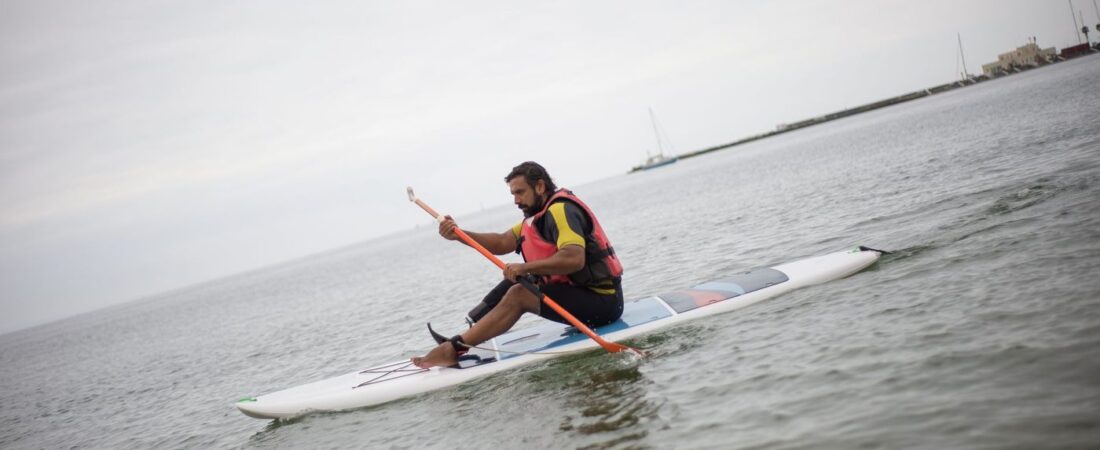
Maritime NZ’s page on its lifejacket wearing rule amendment names paddleboards among the craft it covers. The page, last updated on 8 October 2026, says everyone on board a recreational craft of 6 metres and under must now wear a lifejacket when the craft is underway, anywhere in New Zealand. This article sets out what that page says about the rule, its exclusions and its enforcement, and what Maritime NZ’s communications page says about calling for help. It covers New Zealand only.
What changed on 9 October 2026?
The page’s FAQ gives the start date as 9 October 2026 and says the rule applies on all waterways, inshore and offshore, from lakes, streams and rivers to the New Zealand coast. It lists recreational craft covered as including, but not limited to, paddleboards, small launches, yacht tenders, personal watercraft, and recreational motor and sailing craft. Elsewhere the page names jetskis, dinghies, sailboats and kayaks as examples.
The older requirements are not changing. On all recreational craft, lifejackets must be carried in sufficient numbers for all passengers, and must be worn at times of heightened risk and by a person being towed for activities such as water skiing. The skipper is responsible for the safety of everyone on board.
On why the change was made, the page says research shows smaller craft have a higher risk profile and are over-represented in boating fatalities and serious harm incidents.
What counts as a lifejacket, and what counts as underway?
The page defines a lifejacket as a buoyancy aid meeting an approved standard, either NZS 5823 or an international standard deemed substantially compliant by the Director of Maritime NZ. The term “personal flotation device” has been replaced by “lifejacket” and the definition is otherwise unchanged. The page says maritime rules do not prescribe which type must be worn in each situation.
Fit matters. The page says the New Zealand Standard sets weight ranges, including weight restrictions on some types such as inflatables, and that a lifejacket which does not fit cannot be “properly secured” and so will not meet the rule.
“Underway” means a vessel on the water that is not at anchor, attached to a dock, aground or attached to the shore. The page says the term comes from the 1972 collision regulations and that the definition has been brought into New Zealand law in Maritime Rules Part 22.
Which exclusions might apply to a paddler?
The page lists existing exclusions under Maritime Rule Part 91.4(2), including a surfboard or similar unpowered craft, and says these may also apply to users of craft affected by the new rule. On stand-up paddleboarding specifically, it says the new rule brings an existing exemption for SUP surfing, granted by the Director of Maritime NZ in 2022, into Part 91. It adds that the exemption does not apply to all people using a SUP and applies only when a person is SUP surfing.
Swimming has its own provision. The page says maritime rules regulate activities on the vessel, not recreational swimming, and that a lifejacket does not have to be worn immediately before entering or after exiting the water, even if the craft is underway. It says this only allows for the practical transition of taking a lifejacket on and off, or for jumping and diving repeatedly from the craft, and is tied to someone actively swimming.
What does the page say about penalties and bylaws?
As of the page’s 8 October 2026 update, specific national offences and penalties for the new requirement had not been created yet and, the page said, would likely be in place in a few months. Once created, they can be enforced by police, regional councils, harbourmasters and various Maritime NZ employees. The page says work on them will be led by the Ministry for Cities, Environment, Regions and Transport.
Other tools exist in the meantime. The page says Maritime NZ can still prosecute for significant harm resulting from violations of the maritime rules, and that existing offences for dangerous activity under section 65 of the Maritime Transport Act 1994 may apply in some situations. It also says some regions already have navigational safety bylaws with lifejacket wearing offences, and that offences linked to bylaws consistent with the new Part 91 can be applied. The page adds that focusing on educating the public first is generally good practice.
Two ways to call for help
Maritime NZ’s communications page (last updated 29 July 2026) says to always carry at least two types of communication equipment that will work when wet. It lists VHF marine radio, emergency beacons, flares and mobile phones, and says mobile phones are only helpful if kept dry and when used close to land.
For immediate danger, the page says to make a distress call on a VHF marine radio or set off an emergency beacon. It also lists low-tech ways to attract attention: a horn, a torch used to signal SOS with three short flashes, then three long, then three short, a red flag, or raising and lowering both arms, which it describes as recognised internationally as a distress signal.
The New Zealand Safer Boating Forum, a network of agencies, local body groups and the marine industry that Maritime NZ leads, makes the same recommendation of at least two forms of waterproof communication. Its page says wearing a lifejacket is the most important thing a person can do to keep safe and adds that if you cannot call, no one knows you need help. The lifejacket page’s checklist also says to check the marine weather forecast.
The bottom line
Maritime NZ’s lifejacket page, read on 3 November 2026 and showing a last-updated date of 8 October 2026, says everyone on board a recreational craft of 6 metres and under must wear a lifejacket while it is underway, names paddleboards among the craft covered, and limits the SUP surfing exemption to SUP surfing. The same page says national offences and penalties were still to be created as of that update, and that some regional bylaws already carry lifejacket offences. Maritime NZ’s communications page says to carry at least two types of communication that work when wet.
Sources
- Lifejacket wearing rule amendment, Maritime NZ, last updated 8 October 2026, read 3 November 2026 (maritimenz.govt.nz)
- Communications, Maritime NZ, last updated 29 July 2026, read 3 November 2026 (maritimenz.govt.nz)
- New Zealand Safer Boating Forum, Maritime NZ, page undated, read 3 November 2026 (maritimenz.govt.nz)