
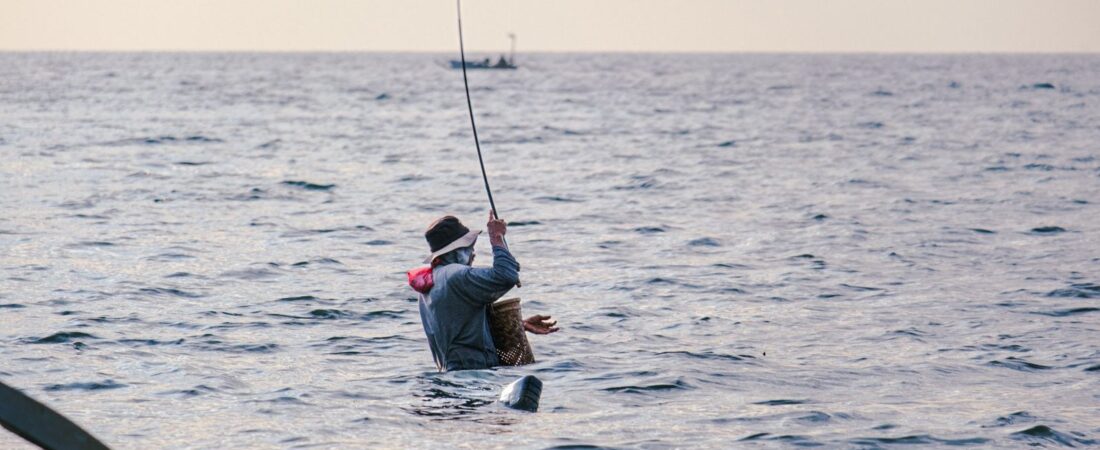
Quick answer: SUP fishing works best on a wide, stable board with plenty of weight capacity and mounting points, a clear standing area, and gear kept low and central. Start on calm, sheltered water, sit or kneel when landing fish, wear your buoyancy aid, and only anchor in slow water, from the nose or tail. You will need a fishing licence or permit in most places: check the official authority for your country, state or province before you cast.
Fishing from a paddle board is quiet, cheap to get into and lets you reach water that is hard to fish from the bank. It also combines two activities that each need attention, so a little planning goes a long way. This guide covers board choice, stability, safety and the licence rules in each of our five countries.
Choosing a board for fishing
Stability and capacity first
REI says wider boards are more stable, and that weight capacity must cover your body weight plus all your gear. Fishing kit adds up fast: rods, tackle, a crate or cooler, an anchor, water and food. Choose a board rated well above your total load.
Features that help
REI points to several features on fishing-focused boards:
- Dugout or recessed decks to store tackle and your catch.
- Attachment points for rod holders, seats and cameras, usually sold separately.
- Inflatable seats strapped to the deck so you can sit when it gets choppy or while fishing.
- Bungee tie-downs for dry bags and coolers.
As a real example of a dedicated design, the BOTE Rackham Aero inflatable fishing board is listed at 12 ft long, 38 inches wide and 7 inches thick, with a 390 lb capacity, a two-chamber recessed deck, cooler tie-down points, slide-in accessory receivers and a sheath for a shallow-water stake-out pole. It was listed at $1,499 on 29 September 2026.
Inflatable or hard?
Both work. REI notes inflatables are easier to store and transport, while solid boards ride a little lower and can feel more stable. For anglers who drive to different lakes or hike in, an inflatable is often more practical. See our inflatable vs hard guide.
Staying stable while you fish
- Keep the standing area clear. Glide’s rigging guide calls this critical for balance and safety.
- Keep weight central. Glide recommends heavier items towards the centre and lighter ones at the nose and tail, and shifting gear until the board sits level.
- Use the basics. REI’s beginner guide advises feet parallel and hip-width apart, knees slightly bent and eyes on the horizon.
- Sit or kneel to land fish and when you need both hands for unhooking. A seat makes this easier.
- Start on flat water. Practise casting close to shore in calm conditions before heading anywhere exposed.
Anchoring safely
An anchor or stake-out pole keeps you on a spot, but it also changes how the board behaves. Kayak Fishing Guide gives advice that applies equally to SUPs:
- Never anchor in fast-flowing water: the current can spin you round and tip you in.
- Never anchor from the side; anchor from the bow (nose) or stern (tail).
- Always wear your buoyancy aid.
In shallow water a stake-out pole pushed into the bottom is a simple option. For kit choices, see our SUP fishing accessories guide.
Safety basics for SUP anglers
- Wear your buoyancy aid or PFD. The Transport Canada Safe Boating Guide includes a specific section for anglers and hunters crossing water, and advises always wearing a lifejacket or PFD when paddleboarding.
- Pick the right leash: Go Paddling says use a quick-release waist belt on flowing or tidal water.
- Keep your phone in a waterproof pouch on your body, as the RNLI advises, not in the tackle crate.
- Watch the wind. The RNLI warns that offshore winds can quickly blow you out to sea, and you drift while you fish.
- Fish with a friend when you can.
Fishing licences and permits by country
Licences are required in most places, and rules change. Always check the official authority before you fish.
England and Wales
GOV.UK says you must have a rod fishing licence for England and Wales if you fish for salmon, trout, freshwater fish, smelt or eel with a rod and line, including on private waters. Children under 13 do not need one and junior licences for 13 to 16 year olds are free. You can be fined up to £2,500 if you cannot show a valid licence. Scotland and Northern Ireland have different rules, linked from the same GOV.UK page.
Ireland
Citizens Information explains that angling is regulated by Inland Fisheries Ireland (IFI). You need a State Licence, plus usually a local permit, to fish for salmon and sea trout. A licence is not needed for trout, pike and coarse fishing, though you may need a local permit, and you can sea fish for almost all species without a licence or permit. It also notes a bag limit of 3 pollack per angler from 1 June 2026.
USA
Fishing licences are issued by each state. The US Fish & Wildlife Service says every state has slightly different rules, and that licences can usually be bought online, by phone or from retailers. Look up your state’s fish and wildlife agency before you go.
Canada
Freshwater licences are provincial or territorial. For tidal (salt) waters in British Columbia, Fisheries and Oceans Canada says all recreational fishers need a BC Tidal Waters Sport Fishing licence to harvest fish and shellfish, with juvenile annual licences free. Check your own province or territory for freshwater rules.
Australia
Rules are set by each state and territory. In New South Wales, the NSW Department of Primary Industries and Regional Development says you must pay the Recreational Fishing Fee and carry a receipt when fishing in both freshwater and saltwater, with fees listed at $7 for three days up to $85 for three years, and several exemptions. Other states run their own schemes.
Getting started checklist
- Check the licence rules for where you will fish.
- Choose a wide, high-capacity board and rig it with the standing area clear.
- Pack buoyancy aid, correct leash, phone pouch, water and sun protection.
- Check wind, tide and flow before you go.
- Practise balance and casting in calm, shallow water first.
Sources
- REI Expert Advice: Paddle board (SUP) buying guide
- REI Expert Advice: How to paddleboard for beginners
- BOTE: Rackham Aero inflatable fishing paddle board
- Glide: How to rig a paddle board for fishing
- Kayak Fishing Guide: How to anchor a kayak in a river
- Transport Canada: Safe Boating Guide TP 511E (2026 edition)
- Go Paddling (Paddle UK): Stand up paddle board leashes
- RNLI: Stand-up paddleboarding safety
- GOV.UK: Fishing licences
- Citizens Information (Ireland): Fishing licences and permits
- US Fish & Wildlife Service: Purchase a fishing license
- Fisheries and Oceans Canada: Recreational fishing licence, Pacific Region
- NSW DPIRD: Recreational fishing fee