Quick answer: Inflatable boards are made from drop-stitch fabric sealed in PVC; the better ones use a fused (laminated) second layer rather than a glued one, which retailers say makes them lighter and stiffer. Most hard boards are an EPS foam core wrapped in fibreglass and epoxy. Carbon fibre is lighter and stiffer but costs more, soft-tops add a cushioned foam deck, plastic boards are cheap but heavy, and wood is used mainly as a thin reinforcing or decorative layer.
Board spec sheets are full of words like “fusion”, “MSL”, “EPS” and “carbon sandwich”. This guide translates them into plain English so you can tell what you are actually paying for. It covers inflatable construction first, then hard board materials.
Part 1: Inflatable board materials
Drop-stitch PVC: the core of every inflatable
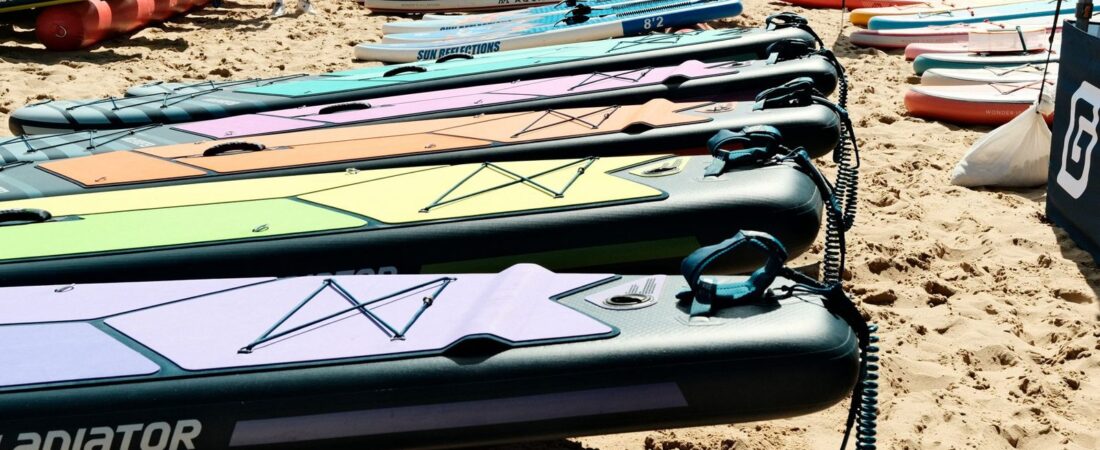
REI explains that inflatable boards have PVC exteriors with drop-stitch construction creating an air core. Drop-stitch is two sheets of fabric joined by thousands of threads. When you pump the board up, those threads pull tight and stop the board bulging, which is why a well-inflated iSUP feels firm rather than like a lilo. REI says a quality inflatable is designed for 12 to 15 psi and should feel very rigid. The SUP Inflatables construction guide describes the same idea: the drop-stitch stops over-expansion and the PVC makes it airtight.
Single skin
The most basic build is drop-stitch covered by one PVC layer. SUP Inflatables describes single-skin boards as lightweight and low priced but with noticeable flex.
Stringer construction
A step up adds a fairly wide PVC strip glued down the centre of the board, borrowing the “stringer” idea from surfboards. SUP Inflatables says this increases stiffness for little extra weight and cost, though some flex remains.
Glued double layer
Here a second full layer of PVC is glued over the first by hand. SUP Inflatables says this adds strength but makes the board heavier, and calls it outdated technology now used mainly by specialist or budget brands.
Fusion or laminated double layer (including MSL)
Instead of glue, the second layer is heat-bonded (laminated) to the base material by machine. SUP Inflatables claims fusion boards are around 20 to 25 percent lighter and 25 to 30 percent stiffer than glued double-layer boards, a saving of about 2 kg, and that they hold their shape better. Treat these as a retailer’s figures rather than independent test results. Red Paddle Co’s “MSL” boards, such as the 10’6″ Ride MSL, use this kind of laminated construction.
Woven drop-stitch
SUP Inflatables describes woven fusion double layer as a newer technology using woven material, and says it is even lighter and stiffer than standard laminated boards, which suits people who carry boards a long way or lighter paddlers. Starboard lists “Woven Dropstitch” among its own inflatable technologies, alongside welded rails and double chamber designs.
Rails and sidewalls
The rails (side edges) take a lot of stress. SUP Inflatables says rail quality varies a lot, notes that premium brands use multi-layer sealed rail construction, and warns that boards with thin sidewalls tend to have lower pressure ratings. When comparing boards, the maximum recommended pressure printed near the valve is a useful clue to build quality.
Part 2: Hard board materials
EPS foam, fibreglass and epoxy
REI says most solid boards have an EPS (expanded polystyrene) foam core wrapped with fibreglass (spelled fiberglass in the US) and epoxy resin, which it calls a fairly lightweight, durable and affordable construction. That is why hard boards are often just called “epoxy boards”. Green Water Sports describes hard boards as a combination of EPS foam, fibreglass, carbon and epoxy resin, moulded to maximise glide, tracking and speed, but notes they scratch and dent more easily than other boards.
Brands often add reinforcement. For example, Starboard’s Starlite construction uses an EPS core of 15 kg per cubic metre density, a deck of 0.6 mm Australian pine wood sandwiched between glass outer skins, and twin T-stringers near the rails that the brand compares to an I-beam.
Carbon fibre
REI says carbon fibre is a lighter and stiffer option but more expensive. Stiffness means more of each stroke goes into moving forward, which is why carbon is common on race boards. The Starboard All Star race board, for instance, is sold in a carbon sandwich construction and listed at several thousand US dollars.
Soft-top (EVA foam deck)
Green Water Sports explains that soft-top boards are built much like hard boards but with a spongy EVA foam top deck and rails for added durability. They suit beginners and people who paddle with dogs, because the soft deck resists claws, but the padding adds weight and costs some performance.
Plastic
REI says plastic SUPs are more affordable but very heavy and lack the performance of other materials. You may see these described as rotomoulded, which refers to the moulding process used to make hollow plastic shells. They make sense for rental fleets and rough handling rather than for paddlers who want glide.
Wood
REI notes some SUPs incorporate lightweight wood for a beautiful appearance. In practice wood usually appears as a thin veneer inside a composite sandwich, as in the Starlite example above, rather than as solid planks. Starboard also lists “Wood Sandwich” among its board constructions.
Materials at a glance
| Material | Weight | Stiffness | Durability | Typical use |
|---|---|---|---|---|
| Single-skin PVC drop-stitch | Light | Some flex | Fair | Entry-level inflatables |
| Fusion / laminated PVC | Lighter than glued | Stiffer than glued | Good | Mid to premium inflatables |
| Glued double-layer PVC | Heavier | Stiff | Strong | Budget or specialist inflatables |
| EPS, fibreglass and epoxy | Fairly light | Rigid | Can ding | Most hard boards |
| Carbon fibre | Lightest | Stiffest | Needs care | Race and premium boards |
| Soft-top EVA | Heavier | Rigid core | Very tough deck | Beginners, dogs, hire |
| Plastic | Very heavy | Rigid | Very tough | Budget and rental |
Ratings are relative and summarise the sources cited in this article.
Paddles are materials too
REI’s paddle guide runs through the same trade-offs: plastic blades with aluminium shafts are affordable and durable, fibreglass is lighter and stiffer, carbon is the lightest and stiffest but usually most expensive, and wood is beautiful but can weigh and cost more. REI points out that most people take a couple of thousand strokes in two hours, so a lighter paddle makes a real difference.
How to use this when buying
- For inflatables, look for “fusion”, “laminated” or similar wording rather than “glued double layer”, and check the maximum pressure.
- For hard boards, check the core and skin: EPS with fibreglass and epoxy is the standard; carbon adds cost and saves weight.
- Match material to use: plastic or soft-top for knocks and hire, carbon for racing, laminated PVC for travel.
- Remember weight on land matters too if you carry your board a long way.
Sources
- REI Expert Advice: Paddle board (SUP) buying guide
- SUP Inflatables: Inflatable paddle board construction
- Starboard: Board construction and technology
- Starboard: Starlite construction (SUP)
- Green Water Sports: The different types of stand-up paddle boards explained
- Vermont Ski and Sport: Starboard All Star 14′ paddle board
- Red Equipment UK: 10’6″ Ride MSL inflatable paddle board package
- REI Expert Advice: How to choose a paddle board paddle