
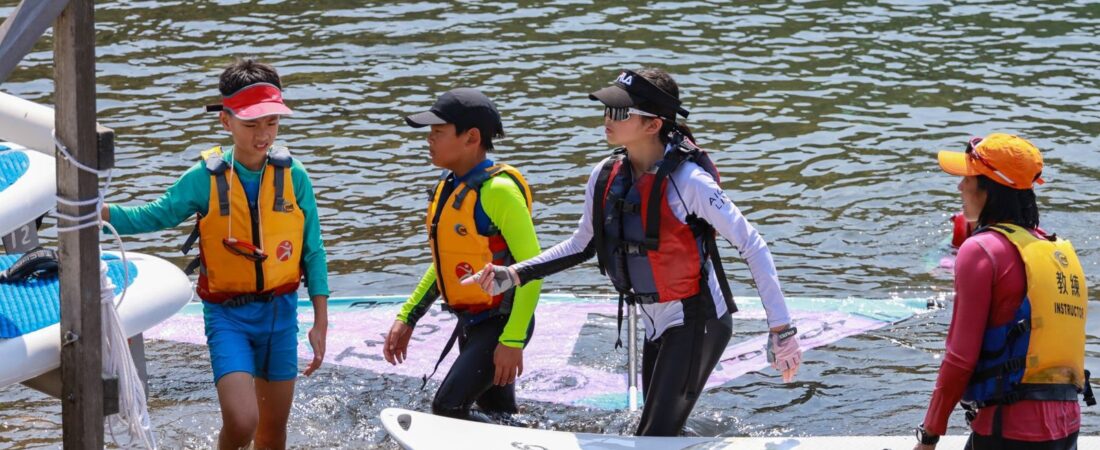
Quick answer: Every time you paddle: wear a buoyancy aid, carry a phone in a waterproof pouch on your body, wear the right leash (a quick-release waist leash on rivers and tidal water, never an ankle leash where you could snag), and avoid offshore winds. Check the forecast and tides, dress for cold water, tell someone your plan, paddle with a friend, and if you fall in unexpectedly, float first to get your breathing under control.
Paddle boarding is relaxed and accessible, which is exactly why people underestimate it. This guide pulls together the advice of lifesaving and boating authorities in the UK, Ireland, the USA, Canada and Australia into one plain-English checklist, with notes where the rules differ.
The four things to do every time
The RNLI worked with training agencies and national governing bodies to agree four things you should do every time you go out:
- Wear a buoyancy aid. It keeps you afloat and gives you time to recover. Check the weight range and chest size, and choose one you can paddle in freely.
- Carry a phone in a waterproof pouch on your body, for example in a buoyancy aid pocket. The RNLI points out it is no use in a dry bag strapped to the board.
- Wear the correct leash for where you are paddling.
- Avoid offshore winds.
Offshore wind: the number one risk at the coast
An offshore wind blows from the land out to sea. The RNLI warns that the water often looks calm and inviting in an offshore wind, but it can quickly blow you and your board far out, making the paddle back exhausting. On a lifeguarded beach, the RNLI suggests checking the orange windsock to see which way the wind is blowing. AdventureSmartUK adds that even a light offshore breeze can sweep you out to sea.
If you get into trouble, the RNLI beginner guide suggests sitting on your board with a leg on each side, and using your paddle in the water as a brake.
Choose the right leash, especially on rivers
A leash keeps you connected to your board, which is a large float. But on moving water the wrong leash can kill. Go Paddling explains:
- Ankle and calf leashes suit lakes, canals, sea bays and surf where there is no risk of snagging.
- On flowing rivers, tidal rivers and tidal races, an ankle leash can snag and trap you. Use a quick-release belt, worn over your buoyancy aid.
- On white water, wear no leash at all.
The Transport Canada Safe Boating Guide is just as direct: a tangled leash on rivers and moving water can pull you underwater, so if you wear one there, it should be waist-mounted with a quick-release you can reach with both hands. It also says never paddle in flood water. The RNLI’s own river example is ankle leashes wrapping around buoys, boats, pontoons or jetties.
Cold water
Cold water, not the air temperature, is what matters when you fall in. The RNLI warns that even in summer the water is often very cold and can cause cold water shock, so consider a wetsuit, and a wetsuit or drysuit in winter. Parks Canada says swimsuits alone are not enough and lists shivering, loss of coordination and numbness as signs of hypothermia.
Transport Canada explains cold water immersion using its 1-10-1 principle. In the first minute, cold shock makes you gasp and hyperventilate, so keep your airway clear, stay calm and slow your breathing; a lifejacket keeps your mouth and nose out of the water. Over roughly the next 10 minutes you lose meaningful movement in your arms, legs and fingers, so focus on self-rescue early.
Float to Live
If you end up in the water unexpectedly without your board, the RNLI’s advice is to Float to Live: float to conserve energy and recover your breathing, then call for help or swim to safety. The NSW Government recommends the HELP (Heat Escape Lessening Posture) position to protect body heat.
Tides, currents and water conditions
- Check the forecast and tide times before you go. The RNLI warns that choppy water is hard for beginners and conditions can change quickly: if in doubt, don’t go out.
- Understand your location. The RNLI notes strong tidal currents can stop you paddling in your chosen direction and tire you quickly.
- Water Safety Ireland lifeguards report seeing paddle boards caught in rip currents, changing tides and offshore winds, and advise choosing a calm body of water and staying close to shore.
- Parks Canada advises checking tide and swell forecasts on the ocean, watching for fog and wind, and getting off the water immediately if you hear thunder or see lightning.
Plan, tell someone, and don’t go alone
- Tell someone where you are going and when you will be back (RNLI, Water Safety Ireland, Parks Canada).
- Paddle with a friend where possible.
- Take a lesson. The RNLI says it is the best way to learn how to get back on your board and read wind and tides, and Water Safety Ireland recommends joining a club.
- Avoid alcohol and cannabis before and during paddling (Parks Canada).
- On lifeguarded beaches, launch and land between the black and white chequered flags (RNLI).
Calling for help
In the UK and Ireland, call 999 or 112 and ask for the Coastguard at the coast, or the Fire and Rescue Service when inland in the UK (RNLI). Elsewhere, use your local emergency number. Surf Life Saving Australia’s Beachsafe advises paddlers to secure themselves to their craft, wear a lifejacket and carry a 406 MHz beacon. Water Safety Ireland suggests a charged phone or a VHF radio in a waterproof bag.
Lifejacket and equipment rules by country
- UK: the RNLI and national governing bodies advise wearing a buoyancy aid every time.
- Ireland: Water Safety Ireland says always wear a lifejacket or buoyancy aid and use a leash at all times; Canoeing Ireland lists an appropriate leash, a buoyancy aid and a means of calling for help as essentials.
- USA: the US Coast Guard Auxiliary explains that paddle boards used beyond swimming, surfing or bathing areas are vessels, needing a Coast Guard approved life jacket per person and a sound device such as a whistle, plus a light at night. NRS summarises that children 12 and under must wear their life jacket. States can add rules.
- Canada: Transport Canada’s equipment table for paddleboards requires a lifejacket or PFD for each person, a reboarding device and a 15 m buoyant heaving line, or, if you wear your lifejacket, a sound-signalling device (plus a watertight flashlight at night or in poor visibility). Paddle Canada explains the rules apply when you are navigating, such as crossing from point A to point B.
- Australia: state rules differ. Safe Transport Victoria requires a Level 50 or 50S lifejacket more than 400 m from shore and strongly recommends a leg leash at all times. The NSW Government recommends a lifejacket, or a leg rope if that is not possible. Royal Life Saving Society Australia says everyone using paddle boards in open water should wear a lifejacket.
Pre-launch safety checklist
- Forecast, wind direction and tides checked
- Buoyancy aid on and fastened
- Correct leash for the water, attached to the board
- Phone charged, in a pouch, on your body
- Whistle, and a light if you might be out late
- Clothing for the water temperature
- Someone knows your plan and return time
- Paddle checked for damage (the RNLI suggests a quick kit inspection before you go)
Sources
- RNLI: Stand-up paddleboarding safety
- RNLI: A beginner’s guide to paddleboarding
- AdventureSmartUK: Paddle boarding kit list
- Go Paddling (Paddle UK): Stand up paddle board leashes
- Transport Canada: Safe Boating Guide TP 511E (2026 edition)
- Parks Canada: Stand up paddleboard safety
- Paddle Canada: Are you using a stand up paddleboard?
- NSW Government: Paddle safety
- NSW Government: When to wear a lifejacket
- Water Safety Ireland: Advice for paddle boarding and kayaking
- Canoeing Ireland: Stand up paddle
- US Coast Guard Auxiliary: Are paddleboards considered vessels?
- NRS: US Coast Guard regulations for stand up paddlers
- Safe Transport Victoria: Paddleboards
- Royal Life Saving Society Australia: Lifejackets
- Surf Life Saving Australia Beachsafe: The right gear