
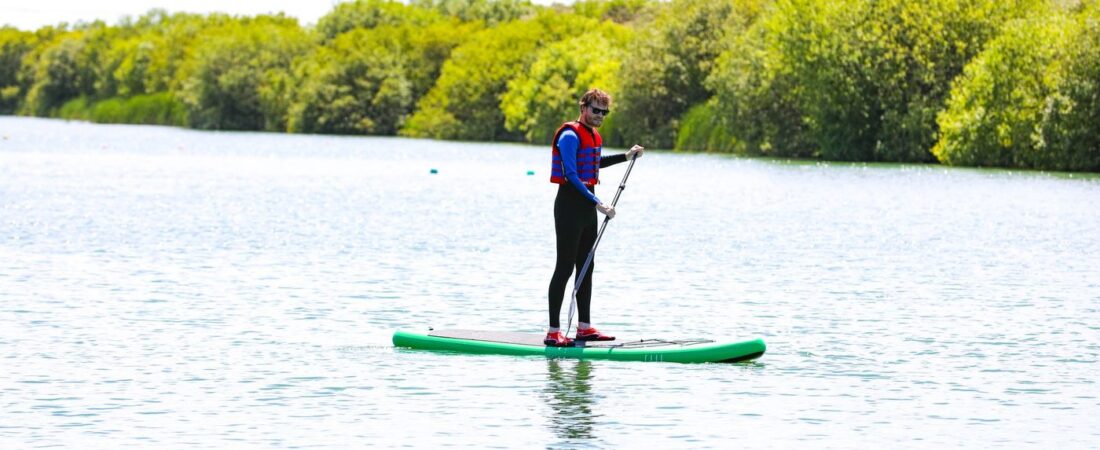
California State Parks’ Division of Boating and Waterways (DBW) names stand-up paddleboards explicitly. Its equipment page says California boating laws require recreational human-powered vessels, listed as canoes, kayaks, stand-up paddleboards and rafts, to carry the safety equipment on its fact sheet. This article reads that page together with a State Parks news release dated 14 May 2026, and sets out the general rule, the exceptions and where the two pages differ in what they list. It covers California only and is general information, not legal advice; check what applies to your waterway.
The general rule: boards are covered
The DBW page names stand-up paddleboards, so the duties below are stated to apply to them. The May 2026 release makes the same point, saying that even non-motorized vessels must carry essential safety equipment when operating on California waterways, and that all paddle craft users, including people using kayaks, canoes and stand-up paddleboards, are required to carry certain items.
Life jackets: carried for everyone, worn by children under 13
DBW says all human-powered vessels, regardless of length, must carry a U.S. Coast Guard-approved life jacket in serviceable condition and of a type and size appropriate for the intended wearer, the conditions and the boating activity. The life jackets must be within easy reach for each person on board. The release likewise says a properly fitted U.S. Coast Guard-approved life jacket is required for each person on board.
The exception to carrying is for children. DBW’s page says that under California state law every child under 13 years of age must wear a U.S. Coast Guard-approved life jacket while the boat is underway, and the release repeats that California law requires children under 13 to wear a life jacket on a moving vessel. Neither page read says that adults must wear one. The release does say to always wear a properly fitted life jacket as a safety tip, and quotes the U.S. Coast Guard’s 2024 Recreational Boating Statistics as showing that 87% of drowning victims were not wearing a personal flotation device. It also says life jacket loaner stations exist at many waterways, where one can be borrowed for the day.
After dark and in poor visibility: lights
On lights, the two pages are worded differently, and both are reported here as worded. DBW says all vessels are required to display navigation lights between sunset and sunrise and during times of restricted visibility, and that on its list a navigation light may be one of the following:
- an electric flashlight or other bright light;
- a lighted lantern showing a white light, exhibited in sufficient time to prevent collision;
- a tricolored lantern;
- all-round green and red lights.
The release says paddle craft users are required to carry a white light when operating between sunset and sunrise or in limited visibility. The DBW page adds that a tricolored lantern should not be used with all-round green and red lights.
Making a noise: sound signals
DBW lists a whistle, bell or other means of making an efficient sound signal. The release uses the shorter description of a sound-signaling device such as a whistle. Both pages put it among the items to carry.
A coastal-waters extra: visual distress signals
Only the DBW page mentions one more category, for coastal waters. It says that one or more devices suitable for night are required between sunset and sunrise, and lists options such as a hand-held red flare or an electric distress light for boats. The 14 May 2026 release does not mention this category, so the two pages are not identical in what they list, and the release does not say which governs.
What the 2026 release adds beyond equipment
The release builds its advice on the word SMART. Beyond the equipment items above, it says to check weather and water conditions before and during a trip, review conditions with local waterway managers and check NOAA marine forecasts, and to dress for the water temperature to protect against cold water shock. It also says to avoid alcohol and drugs and to tell someone the plan, with trip details, route and expected return time shared with a trusted contact.
The release adds that the Division reminds boaters of the need to follow watercraft inspections and to “clean, drain and dry” their watercraft before entering and leaving waterways, to help combat the spread of invasive mussels.
The bottom line
On the two State Parks pages read, a stand-up paddleboard in California is treated as a human-powered vessel that must carry a U.S. Coast Guard-approved life jacket for each person on board, a sound signal and, from sunset to sunrise or in poor visibility, a light. Children under 13 must wear a life jacket while underway, while the pages read do not require adults to wear one, though the release advises wearing one. The DBW page lists navigation light options and a night-time visual distress signal rule for coastal waters that the 2026 release does not mention. This article reads only these two pages, so rules set for individual waterways, and federal rules, are not covered.
Sources
- Safety Equipment (human-powered vessels), Division of Boating and Waterways, California State Parks, page undated, read 5 November 2026 (dbw.parks.ca.gov)
- Get on Board: Your Safety Starts with SMART Habits During National Safe Boating Week, California State Parks news release, 14 May 2026, read 5 November 2026 (parks.ca.gov)