
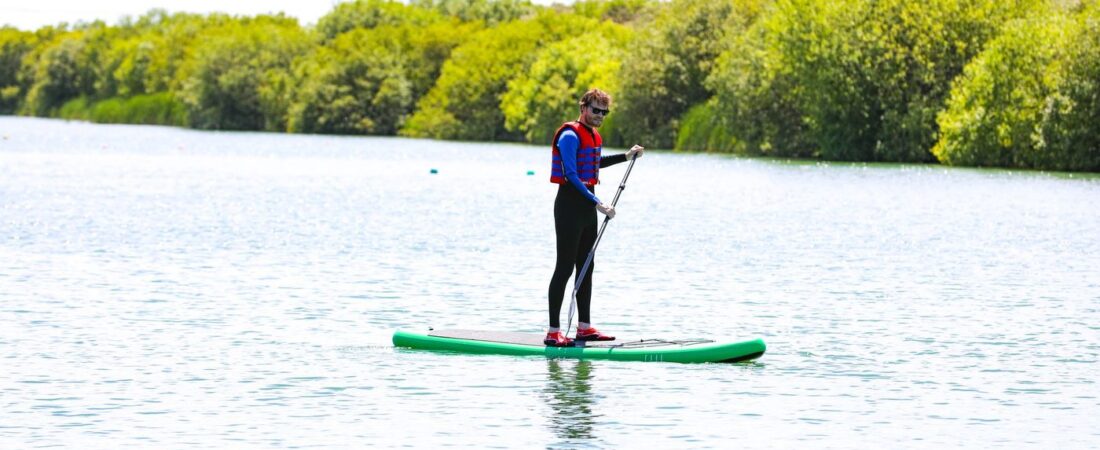
Scotland’s canals are managed by Scottish Canals, and its website carries paddling advice, a trip registration form and the Scottish Canoe Association’s Paddlers’ Access Code. None of the pages read for this guide is dated. Most of the wording speaks of “paddlers”, canoes and kayaks; paddleboards are named on the registration form, which asks for a number of paddleboards alongside canoes and kayaks, so the guidance below is reported as written for paddlers in general. It covers Scotland’s canals only, is general information, and conditions and access arrangements can change at short notice.
Before the Trip: Registration and Group Permission
The etiquette and safety page asks paddlers to register in advance so that Scottish Canals can keep track of all watercraft on its canals for safety reasons. The Great Glen Canoe Trail page says the same, using the word “recommend”, and adds that submitting the form does not currently produce an email acknowledgement. The Paddlers’ Access Code takes a slightly different line: on some canals access is managed and a paddler may be required to register the activity with the operator.
The registration form lists five canals: the Caledonian, Monkland, Union, Forth and Clyde, and Crinan. It asks for the number of people, the number under 18, the number of canoes, kayaks and paddleboards, and whether the paddler has insurance. A note on the form says organised groups and commercial operators must obtain permission in advance from the Caledonian Canal office.
On the Water: Courtesy, Buoyancy and Where to Paddle
The canal code on the etiquette page asks paddlers to be courteous to other users, including motorboats, rowers and fishermen, to move to canal right and offer space for other craft to pass, to let faster craft pass as soon as possible, and to keep towpaths clear for walkers, cyclists and works access. The Paddlers’ Access Code adds that on canals paddlers should be aware of other traffic and give way to motorised craft.
The same page says paddlers should always wear a suitable buoyancy aid when on or near the water, and suggests paddling with friends, having suitable experience and safety skills, taking a map, mobile phone and first aid kit, and telling someone the route and expected time. It also suggests considering a change of clothes, a towel and a group shelter.
Locks and Lifts
Where a route meets a lock, the etiquette page says paddlers need to portage around it, and that how this is done depends on the type of boat, the size of the group and the amount of equipment. Scottish Canals says it always advises paddlers to bring their own portage trolleys. The Paddlers’ Access Code states that access rights do not apply to passage through locks and lifts.
Tunnels
For tunnels, the etiquette page says any paddling group should be led by a responsible, competent adult, and all paddlers should wear appropriate flotation devices with whistles. It says Scottish Canals would always recommend that one paddler walk through the tunnel ahead of the group to advise of any oncoming craft, and that groups should carry waterproof head torches, hi-viz vests and glow sticks, with a rear red light at the stern of the last craft. A paddler unsure of the skills needed is told to portage around the tunnel using the towpath walkway.
The Falkirk Wheel
The etiquette page says Scottish Canals may allow groups of paddlers to use the Falkirk Wheel. A group that has pre-booked a timeslot checks in with the Basin Controller on arrival and portages to the slipway, and must not go onto the slipway until the Basin Controller says so. The page says passage through the wheel must be booked at least 24 hours in advance by calling the Basin Controller. A group portaging around the wheel is directed to Portage Route 2 on the page’s map, using portage trolleys and working as a team on the uphill carry.
The Caledonian Canal: Lochs and Camping
The Great Glen Canoe Trail page describes a 60 mile route for a canoe or sea kayak and says over 4,000 paddlers visit the Caledonian Canal each year. It says much of the route is open water rather than canal. The registration form adds that conditions on Loch Ness and Loch Lochy are equivalent to sea conditions and recommends that only experienced open water paddlers, or those travelling as part of a guided group, paddle those sections.
The form says responsible informal camping is allowed only in designated locations, on human-powered trips with no cars, vans or motorbikes, and that wild camping is not permitted on the Caledonian Canal. The trail page lists the conditions for the designated spots, including using only the marked pitches, no campfires (camping stoves only), and taking all litter away.
What the Pages Do Not Say
The pages read do not give a separate rule for stand-up paddleboards and do not say who checks registrations. The registration form says canal operating times and access arrangements may be subject to change at short notice, and tells anyone with specific deadlines or timescales to contact the canal office for advice. The Paddlers’ Access Code describes the statutory right of access in the Land Reform (Scotland) Act, and its canal paragraph is the one quoted above.
The bottom line
For paddlers on Scotland’s canals, Scottish Canals asks for advance registration (the Paddlers’ Access Code says that on some managed canals it may be required), asks paddlers to wear a suitable buoyancy aid, move to canal right and give way to motorised craft, and to portage around locks. It gives specific advice for tunnels and says passage through the Falkirk Wheel must be booked at least 24 hours in advance. On the Caledonian Canal, the form says Loch Ness and Loch Lochy conditions are equivalent to sea conditions and that wild camping is not permitted. The pages are undated, are written for paddlers generally, and say arrangements may change at short notice.
Sources
- Etiquette and safety, Scottish Canals, page shows no date, read 10 November 2026 (scottishcanals.co.uk)
- Scottish Canoe Association: Paddlers’ Access Code, published on the Scottish Canals website, page shows no date, read 10 November 2026 (scottishcanals.co.uk)
- Paddle Registration (Kayak), Scottish Canals, page shows no date, read 10 November 2026 (scottishcanals.co.uk)
- Discover The Great Glen Canoe Trail, Scottish Canals, page shows no date, read 10 November 2026 (scottishcanals.co.uk)