Quick answer: Choose an inflatable if you have limited storage, no roof rack, want to hike or travel with your board, or plan to paddle rivers with rocks or do yoga. Choose a hard (solid) board if performance, glide and efficiency matter most and you have space to store it and a safe way to carry it on a car. For most beginners, a good inflatable is the practical choice.
Inflatable or hard is the first big decision most new paddlers face. Both are proper paddle boards, and both come in every type from all-round to race. The differences are about how they are built, how they feel on the water and how they fit into your life off the water.
How each type is built
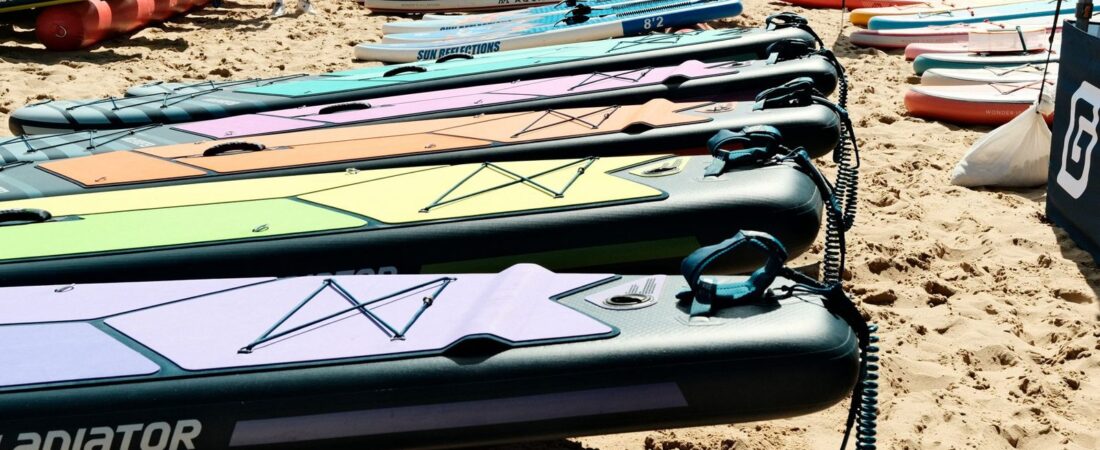
Inflatable boards (iSUPs): REI explains that inflatables have PVC outer skins with drop-stitch construction inside. Drop-stitch means two layers of fabric joined by thousands of threads, which stop the board ballooning when you pump it up hard. REI says a quality inflatable is designed to be inflated to 12 to 15 psi and should feel very rigid when fully inflated. They come with a pump and a storage bag. Some brands rate their boards higher, so always follow your own board’s printed range.
Hard boards: REI says most solid boards have an EPS foam core wrapped in fibreglass (fiberglass in the US) and epoxy. Carbon fibre is lighter and stiffer but more expensive, plastic boards are cheaper but very heavy, and some boards use thin wood layers for looks and strength. Our materials guide explains each in detail.
Side-by-side comparison
| Factor | Inflatable | Hard (solid) |
|---|---|---|
| Storage | Rolls into a backpack-style bag | Needs wall, garage or rack space |
| Transport | Fits in a car boot (trunk), train or plane | Needs a roof rack or van |
| Set-up time | Pump up before every session | Ready to go |
| Performance | Less efficient to paddle | Faster, smoother glide |
| Knocks and rocks | Handles bumps well | Can ding and crack |
| Falling on it | Softer | Harder landing |
| Price | Generally less expensive | Often more expensive |
The table summarises the pros and cons given by REI and the RNLI’s beginner guide.
The case for inflatable
Storage and travel
This is the biggest reason people choose inflatable. REI says inflatables can be rolled up and stored in a cupboard (closet), the boot of a car or even checked in on a plane, and the bags usually have backpack straps so you can hike to a remote lake. If you live in a flat or have no garage, an inflatable is often the only realistic option.
No roof rack needed
A hard board has to be strapped securely to a roof rack. REI quotes one of its staff saying paddle boards act like kites on top of cars, and warns against simply running straps through your car windows. REI also notes that tie-down car racks can cost as much as a good SUP, so skipping the rack is a real saving.
Durability and comfort
The RNLI calls inflatables surprisingly sturdy and durable, and points out they are easier on your body because falling on a hard board can hurt. REI adds that inflatables handle bumps against rocks and logs better than a solid board, which is why they are the usual choice for whitewater, and that their slightly softer deck is good for yoga.
Price
Both REI and the RNLI say inflatables are generally less expensive. For real numbers, see our paddle board price guide.
The case for hard boards
Performance
REI says solid boards offer the best performance on the water, travelling faster, smoother and with less effort than an inflatable. The RNLI notes they are more agile and often used for SUP surfing and racing.
Fit and feel
Solid boards come in a wider variety of sizes and finely tuned shapes, according to REI, so you are more likely to find one that fits you exactly. REI also says a solid board is a little more rigid and rides lower in the water, which can feel more stable, especially in waves.
No pumping
You simply carry it to the water. With an inflatable, the RNLI stresses that you must pump to the manufacturer’s recommended pressure, or the board will be hard to paddle. That takes time and effort every session, although electric pumps help.
The downsides to weigh up
Inflatable: REI lists them as potentially less stable than solid boards and less efficient to paddle. An underinflated board feels soft and bendy, so budget time to pump properly. Valves and seams also need care; see our care guide.
Hard: the RNLI says they are more difficult to store, heavier and often more expensive. Green Water Sports adds that hard boards scratch and dent more easily and need more maintenance. Tower Paddle Boards warns that if a ding goes through the outer skin you should stop paddling until it is sealed, or water can permanently damage the foam core.
What about soft-top boards?
There is a middle ground. Green Water Sports describes soft-top boards as having a similar construction to hard boards but with a spongy EVA foam deck and rails. They are tough and forgiving for beginners, and the soft deck protects the board from dogs’ claws, but they lack the performance of a hard board and still need rack space.
Which should you buy?
Choose inflatable if you:
- Live in a flat, apartment or anywhere without a garage.
- Do not have (or want) a roof rack.
- Want to travel, take trains or fly with your board.
- Paddle rivers with rocks, or want a softer deck for yoga.
- Are a beginner who expects to fall in a lot.
Choose hard if you:
- Want maximum glide for touring, racing or surfing.
- Paddle often and hate pumping up.
- Have storage space and a safe roof rack set-up.
- Launch close to home.
Try before you buy
REI suggests renting or borrowing gear for your first outing or two before buying. Many hire centres and schools have both types, so you can feel the difference yourself. The RNLI also recommends booking a lesson, which will teach you how to get back on your board and read the wind and tides, whichever board you choose.
A note on terms
In the UK and Ireland you will hear “buoyancy aid” and “boot”; in the USA and Canada the same things are usually called a “life jacket” or “PFD” and a “trunk”. Australians often say “leg rope” for a leash. Inflatable boards are widely shortened to “iSUP” everywhere.