
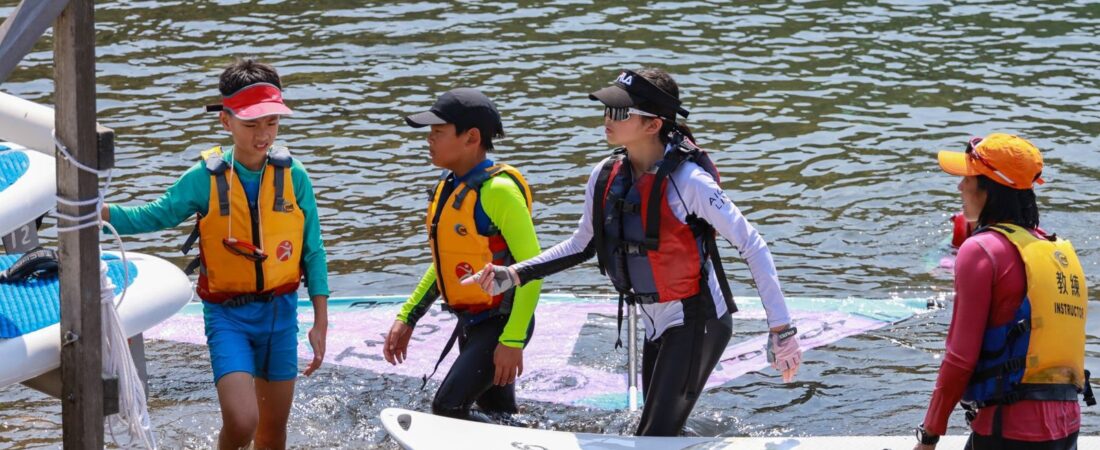
Quick answer: Beyond the board, you need a correctly sized paddle, the right leash for your water (a quick-release waist leash on rivers and tidal water), a buoyancy aid or life jacket, a pump and fin for inflatables, a way to call for help kept on your body (a phone in a waterproof pouch), a whistle, clothing for the water temperature rather than the air, and a dry bag. In the USA and Canada some of this kit is a legal requirement once you are paddling as a vessel.
Most board packages include a pump, bag, fin and basic paddle, but not always the safety kit. This guide covers each essential, why it matters and where the rules differ between the UK, Ireland, the USA, Canada and Australia.
1. A paddle that fits
REI says the right recreational paddle length puts the T-grip in the bend of your wrist when you stand the paddle upright and reach overhead; online, add about 8 to 12 inches (20 to 30 cm) to your height. Adjustable paddles are handy for sharing. Lighter materials (fibreglass, carbon) cost more but tire you less. REI’s staff even argue the paddle is a more important purchase than the board.
2. The right leash
A leash keeps you attached to your board, which is a big float. Go Paddling, from Paddle UK, gives this guidance:
- Coiled leash: for general paddling.
- Straight leash: for surfing only.
- Ankle or calf leash: for lakes, canals, sea bays and surf where there is no risk of snagging.
- Quick-release waist belt: for flowing rivers, tidal rivers and tidal races, where an ankle leash could snag and trap you. Wear it over your buoyancy aid.
- White water: no leash at all, to avoid entrapment.
The Transport Canada Safe Boating Guide agrees, saying ankle or leg leashes are only meant for flat, calm water and that on moving water any leash should be waist-mounted with a quick-release you can reach with both hands. Australians often call a leash a “leg rope”.
3. Buoyancy aid, life jacket or PFD
A buoyancy aid (UK and Ireland), life jacket or PFD (personal flotation device, the usual terms in North America and Australia) keeps you afloat and gives you time to recover if you fall in. The RNLI advises checking the weight range and chest size and choosing one that lets you paddle freely.
Rules by country
- UK: the RNLI and UK national governing bodies list wearing a buoyancy aid as one of four things to do every time you go out.
- Ireland: Water Safety Ireland says always wear a lifejacket or personal buoyancy aid, and Canoeing Ireland lists a buoyancy aid as essential kit. Separately, Citizens Information explains that Irish regulations require lifejackets to be worn on boats and watercraft under 7 metres and by anyone under 16 on pleasure craft; it does not spell out how this applies to paddle boards, so wearing one is the safe choice.
- USA: the US Coast Guard Auxiliary explains that paddle boards used outside swimming, surfing or bathing areas are vessels and need a Coast Guard approved life jacket for each person. NRS summarises that adults 13 and over must carry one, children 12 and under must wear one, and belt-pack inflatables only count if worn. States can add stricter rules.
- Canada: Transport Canada’s guide lists stand-up paddleboards in its minimum equipment table: a lifejacket or PFD for each person, a reboarding device and a buoyant heaving line at least 15 m long, or, if everyone is wearing a lifejacket or PFD, just a sound-signalling device (plus a watertight flashlight at night or in poor visibility). It also advises always wearing one, and says inflatable PFDs are not allowed for under-16s or white-water paddling.
- Australia: rules are set by each state. In New South Wales, the NSW Government recommends wearing a lifejacket on a SUP, or a leg rope if that is not possible. In Victoria, Safe Transport Victoria says a Level 50 or 50S lifejacket must be worn when more than 400 m from shore and strongly recommends wearing one at all times. Royal Life Saving Society Australia says everyone using paddle boards in open water should wear one.
4. A pump (and the right pressure)
Inflatables come with a hand pump. The RNLI stresses inflating to the manufacturer’s recommended pressure or the board will be hard to paddle. If you use an electric pump, Paddling Magazine notes most manufacturers recommend topping up the last 10 to 20 percent by hand to avoid over-inflation, and says never to use an air compressor.
5. Fin
REI explains that fins give tracking and stability: bigger fins track straighter, smaller fins turn more easily. Most are removable. Paddling Magazine calls the fin the most fragile part of an inflatable and suggests always setting the board down fins up. It also notes most major brands use a universal fin box, so replacements are easy to find.
6. A way to call for help, on your body
The RNLI says carry a phone in a waterproof pouch on you, for example in a buoyancy aid pocket, because “it is no good in a dry bag attached to your board”. In the UK and Ireland call 999 or 112 and ask for the Coastguard at the coast (in the UK, the Fire and Rescue Service inland). Water Safety Ireland also mentions a VHF radio as an option. Surf Life Saving Australia’s Beachsafe advises paddlers to secure themselves to their craft, wear a lifejacket and carry a 406 MHz beacon.
7. Whistle and light
In the USA, NRS says a whistle or other sound device is required, and a light after sunset. Transport Canada lists a sound-signalling device and, at night or in poor visibility, a watertight flashlight, and suggests attaching a pealess, non-metallic whistle to your PFD. Victoria requires a white light at night or in reduced visibility. A whistle is cheap and useful everywhere.
8. Clothing for the water, not the weather
The RNLI says in winter you will want a wetsuit or drysuit, and even in summer the water is often cold enough to cause cold water shock, so consider a wetsuit. Parks Canada warns that bathing suits alone are inadequate in cold water. REI suggests quick-drying clothes in mild conditions, plus sun protection and extra layers in a dry bag.
9. Dry bag
REI recommends a dry bag clipped to a D-ring or bungee for keys, spare layers and a repair kit. Keep the phone on you, not in the bag.
10. Small extras worth packing
- Repair kit (REI suggests patches, a spare bungee and a valve cover).
- A small first aid kit.
- Water, snacks and sunscreen.
For a printable version, see our weekend packing list.
Sources
- RNLI: Stand-up paddleboarding safety
- RNLI: A beginner’s guide to paddleboarding
- REI Expert Advice: Paddle board (SUP) buying guide
- REI Expert Advice: How to choose a paddle board paddle
- Go Paddling (Paddle UK): Stand up paddle board leashes
- Transport Canada: Safe Boating Guide TP 511E (2026 edition)
- Water Safety Ireland: Advice for paddle boarding and kayaking
- Canoeing Ireland: Stand up paddle
- Citizens Information (Ireland): Boat licences and safety regulations
- US Coast Guard Auxiliary: Are paddleboards considered vessels?
- NRS: US Coast Guard regulations for stand up paddlers
- NSW Government: When to wear a lifejacket
- Safe Transport Victoria: Paddleboards
- Royal Life Saving Society Australia: Lifejackets
- Surf Life Saving Australia Beachsafe: The right gear
- Parks Canada: Stand up paddleboard safety
- Paddling Magazine: 10 unbreakable rules of inflatable paddleboard maintenance