
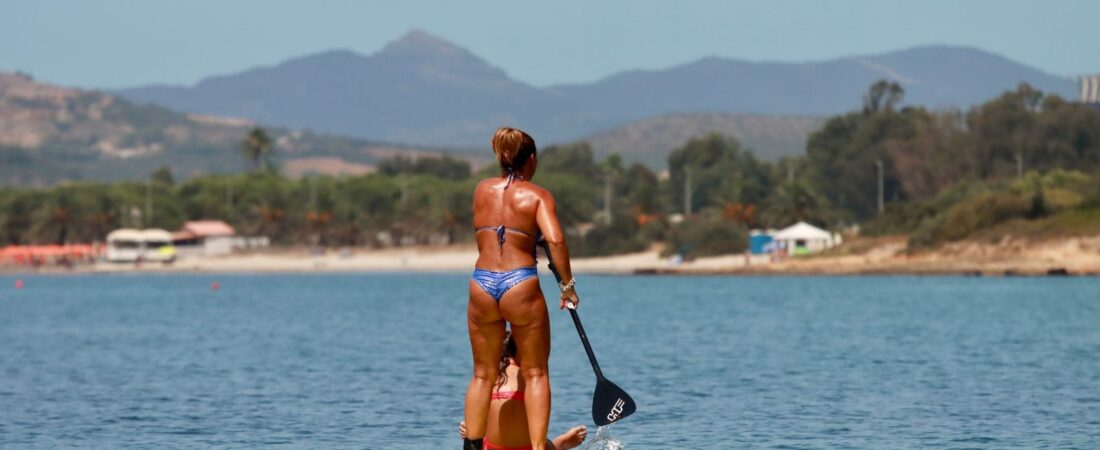
Quick answer: Start in knee-deep, calm water. Kneel just behind the carry handle, then bring one foot at a time to where your knees were and rise slowly, feet hip-width apart, knees soft, eyes on the horizon. Hold the paddle with the blade angled forward, top hand on the T-grip, and switch sides every three or four strokes to go straight. Turn with a wide sweep stroke or a reverse stroke. When you fall, aim away from the board, then climb back on from the side using the centre handle.
Most people can stand up and paddle on their first session with a little instruction, according to REI’s beginner guide. This guide takes you from the beach to your first turns, with the techniques recommended by REI and the RNLI.
Before you start
- Book a lesson if you can. The RNLI says an instructor can teach you how to grip and use the paddle, balance, turn and get back on, and point you to good local spots.
- Pick easy water. REI suggests a small, calm lake or pond free of boats and buoys, with a sandy beach to wade in from, on a sunny day with little wind. The RNLI suggests calm, sheltered water such as a protected bay and, at the coast, a lifeguarded beach.
- Kit up. Buoyancy aid (life jacket or PFD in North America and Australia), the right leash, clothing for the water temperature and a phone in a waterproof pouch. See our essentials guide.
- Size your paddle. REI says the T-grip should sit in the bend of your wrist when you stand the paddle up and reach overhead.
- Go with a friend and plan for about an hour on your first outing (REI).
How to stand up
REI’s step-by-step method:
- Stand beside the board in about knee-deep water, deep enough that the fin does not touch the bottom.
- Hold the edges and climb on to a kneeling position just behind the centre of the board. The carry handle marks the centre.
- Keeping your hands on the board for stability, move one foot at a time to where your knees were.
- Do not spring up. Raise your chest first with your knees bent, then straighten your legs to stand.
It is fine to paddle on your knees for a while first to get a feel for the board. The RNLI also suggests practising getting on the board, so you are confident for the moment you least expect to fall in.
How to balance
REI and the RNLI agree on the basics:
- Feet parallel, about hip-width apart, centred between the rails (edges).
- Toes forward, knees slightly bent, back straight.
- Head and shoulders steady; shift your weight with your hips.
- Look at the horizon, not your feet. The RNLI says looking down can make you less stable and more likely to fall.
The RNLI, quoting Go Paddling, sums it up as standing or kneeling as close to the middle as possible, feet hip-width apart, a slight bend in the knees and your core engaged.
How to hold the paddle
REI says beginners commonly hold the paddle the wrong way round. Two rules:
- The blade angles forward, away from you, towards the nose of the board.
- Hands: when paddling on the right side, your left hand is on the T-grip and your right hand a few feet down the shaft. Swap hands when you switch sides.
The forward stroke
- Reach about two feet (60 cm) forward and push the whole blade under the water.
- Draw it back to your ankle, then lift it out.
- Keep your arms fairly straight and twist from your torso. Push down with your top hand rather than pulling with your lower arm.
REI suggests thinking of pulling the board past the paddle. To go straight, do three or four strokes on one side, then switch. The more vertical the paddle, the straighter you will go.
How to turn
Sweep stroke
Useful whether you are moving or standing still. Paddling on the right: rotate so your right shoulder comes forward, plant the blade near the nose, and sweep it out in a wide arc towards the tail, using your torso, hips and legs. REI says a sweep on the right turns the board left, and vice versa.
Reverse stroke
Used to slow down, stop and turn. On the right: reach back near the tail, bury the blade, and push it forward, twisting from your torso. REI says a reverse stroke on the right turns the nose to the right.
Tighter turns
Because a sweep on the right turns you left and a reverse on the left also swings the nose left, you can combine the two for a tighter turn.
How to fall safely
You will fall in; REI points out that even experienced paddlers do. To make it safe:
- Aim to fall to the side, into the water, not onto the board. REI says falling onto the board is more likely to cause injury.
- Try to hold on to your paddle. If you lose it, get back on the board first, then hand-paddle to the paddle.
If you end up in the water unexpectedly and feel the shock of cold, the RNLI advises you to Float to Live: float, recover your breathing, then get back on or call for help.
Getting back on
- Move to the side of the board, near the centre.
- Grab the centre carry handle with one hand.
- Let your legs float up behind you, then kick while pulling on the handle to slide on to the board.
- Kneel first, then stand up again as before.
Using the wind
REI suggests that if you have to paddle into the wind, do it on the way out, so the wind helps you home when you are tired. At the coast, never go out in an offshore wind; the RNLI says it can quickly carry you out to sea. If you get into difficulty, the RNLI suggests sitting astride the board and using the paddle as a brake.
Your first-session checklist
- Calm, sheltered water, light wind, a friend with you
- Buoyancy aid and the right leash on
- Board pumped to the recommended pressure (the RNLI says an underinflated board is hard to paddle)
- Paddle sized, blade facing forward
- Start kneeling, then stand
- Practise forward, sweep and reverse strokes
- Practise falling in and getting back on near the shore
- Head back before you are tired
Next, read our safety guide before you paddle anywhere with tides, currents or wind.