
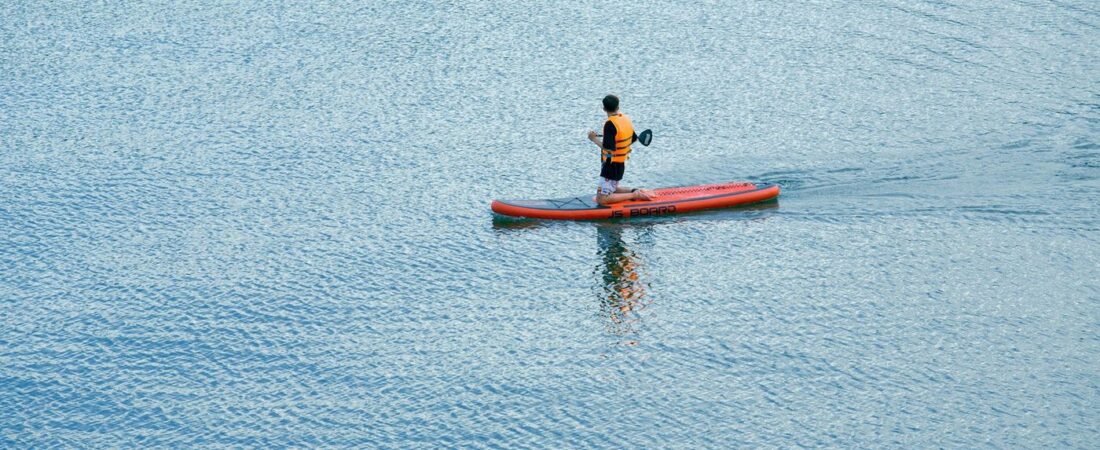
Three organisations publish short pages for paddle boarders on tidal and coastal water: the RNLI, Dart Harbour and the King’s Harbour Master (KHM) Portsmouth, whose paddle sports page is on the Royal Navy website. The RNLI says it worked with training agencies and national governing bodies on four things to do every time out: wear a buoyancy aid, carry a phone in a waterproof pouch, wear the correct leash and avoid offshore winds. None of the three pages shows a date, and each words its checklist as tips, pointers or considerations. This guide reports what each says, attributed, and does not treat any of them as a legal requirement. Whether a harbour byelaw applies is a question for the harbour itself.
Side by Side: What Each Page Tells a Paddler to Do
| Topic | RNLI | Dart Harbour | KHM Portsmouth |
|---|---|---|---|
| Flotation | Wear a buoyancy aid, which it calls a type of Personal Floatation Device (PFD) | Wear a PFD | Wear a suitable serviced buoyancy aid or lifejacket for the activity |
| Leash | Wear the correct leash; a quick release waist leash in tidal or flowing water | Attach the leash, ideally with a quick release around the waist | Always use a paddle board with the right leash |
| Calling for help | A phone in a waterproof pouch, carried on the body | A mobile in a waterproof bag, or a VHF radio for someone suitably trained | A mobile phone in a waterproof bag, or VHF |
| Wind and tides | Avoid offshore winds; check the forecast and tide times | Avoid offshore winds; check tides and weather | Avoid offshore winds; check the tide times and the forecast |
| Telling someone | Say where you are going and when you will be back | Tell someone where you are going and when you are likely to be back | Always tell somebody your route and time of return |
Where the Wording Differs
On flotation, the RNLI says a buoyancy aid gives extra flotation and time to recover after a fall, and that the right size matters. Dart Harbour says PFD and KHM Portsmouth says buoyancy aid or lifejacket, and only KHM Portsmouth uses the word serviced.
On the leash, the RNLI says most boards come with an ankle leash that may not suit the water being paddled. Where the water is tidal or flowing, such as a river, with a risk of entrapment or being caught on an object, it says to wear a quick release waist leash. Dart Harbour says a quick release leash around the waist is ideal and that staying with the board aids recovery. The Portsmouth page names no leash type.
On the phone, the RNLI says to carry it on you, for example in a buoyancy aid pocket or around the neck, because a phone in a dry bag attached to the board is no good if you are in trouble. Dart Harbour and KHM Portsmouth both say a mobile in a waterproof bag, and neither says where the bag should be carried.
Wind, Tide and Looking Ahead
The RNLI explains offshore winds as winds blowing from the shore out to sea. It says the water can look calm and that these winds will quickly blow a paddler and board far out to sea, which can make it extremely tiring and difficult to paddle back. On a lifeguarded beach, it says to watch for the orange windsock. It also says the conditions can change quickly.
Dart Harbour adds a tide tip the RNLI page does not give: look for neap tides, which it says are easier to paddle against. KHM Portsmouth tells paddlers to check the tide times and points to a tide tables page.
Large Vessels, Jetties and Piers
Dart Harbour says there are often large passenger vessels on the Dart, along with many other leisure vessels, and that a paddler will spot them first. Its advice is to keep out of the main channel and, if it has to be crossed, to cross as a group rather than individually. KHM Portsmouth says to keep a good look out for other water users, to obey the International Rules for the Prevention of Collisions at Sea (IRPCS) and not to paddle under jetties and piers. The RNLI page text read for this guide does not mention other vessels.
Points That Only One Page Makes
- RNLI: if you end up in the water, Float to Live; in summer the water is often still very cold, and a fall may bring cold water shock, so it says to consider a wetsuit.
- Dart Harbour: try to paddle with somebody else or join a local club. The RNLI says, if you can, always go with a friend.
- KHM Portsmouth: do not drink alcohol and paddle; label your property in case you are parted from your equipment; wash your kit at the end of the paddle to avoid contamination from invasive species; take litter and food waste home.
If Something Goes Wrong
The RNLI says that in a coastal emergency you should call 999 and ask for the coastguard, and that inland you should ask for the Fire and Rescue service. Dart Harbour says that in difficulty you should stay with your gear and call for help, and that in an emergency you should dial 999 and ask for the Coastguard. Dart Harbour also asks for near misses to be reported on its website.
The bottom line
The RNLI, Dart Harbour and KHM Portsmouth each say to wear a buoyancy aid, PFD or lifejacket, to carry a phone or other means of calling for help, to use a leash, to check the weather and tides, to avoid offshore winds and to tell someone the plan. They differ on the detail: the RNLI wants a quick release waist leash in tidal or flowing water and the phone on the body, Dart Harbour says a quick release waist leash is ideal, and only Dart Harbour and KHM Portsmouth speak about other vessels. All three are advice pages with no date, and none of them is a statement of a harbour’s current rules.
Sources
- Stand-up paddleboarding safety, RNLI (rnli.org), page undated, read 12 November 2026
- Paddleboarding on the Dart, Dart Harbour (dartharbour.org), news item, page shows no date (its web address carries 2022/05/22), read 12 November 2026
- Paddle sports in Portsmouth Harbour, King’s Harbour Master Portsmouth, Royal Navy (royalnavy.mod.uk), page undated, read 12 November 2026