
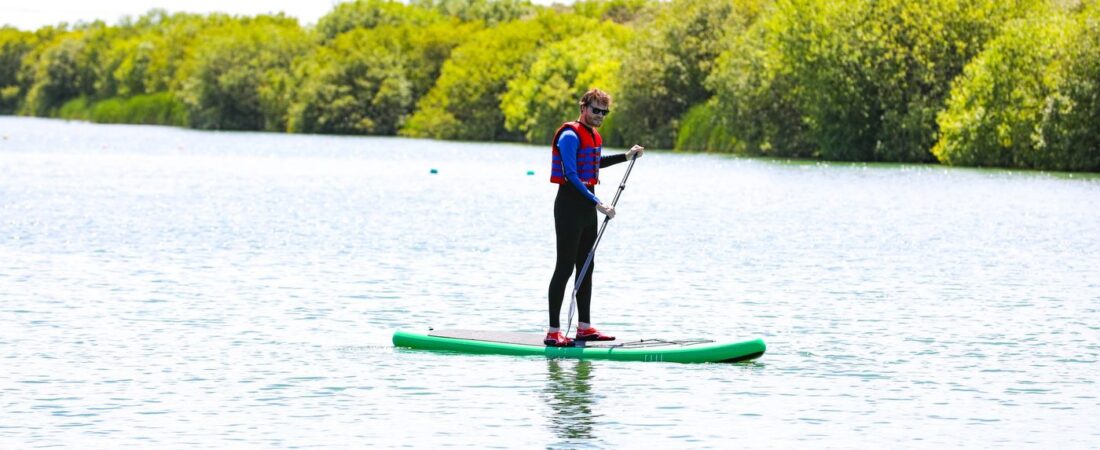
A stand-up paddle board can feel like a toy, but regulators in Canada and the United States describe it in boating terms. Transport Canada lists paddleboards among human-powered pleasure craft, and the US Coast Guard says a stand-up paddleboard is considered a vessel once it is used beyond the narrow limits of a swimming, surfing or bathing area. This guide sets out what each agency’s own pages say about lifejackets, leashes and signalling. Rules in other countries, and state, provincial or local rules, may differ.
Is a paddle board counted as a boat?
Transport Canada’s page on operating a human-powered craft says human-powered water craft include any pleasure craft operated without a motor, naming paddleboards alongside sailboats, sailboards, canoes, kayaks and rowing shells. It says these craft must carry certain safety equipment as specified in the Small Vessel Regulations and the Transport Canada Safe Boating Guide. Its lifejacket page adds that Transport Canada classifies stand-up paddleboards as human-powered vessels if you are using them to take a trip or do a circuit such as a group crossing.
The US Coast Guard’s FAQ answers the question “Am I required to carry a Life Jacket on my Stand Up Paddleboard (SUP)” with “Yes”, because a SUP used beyond those narrow limits is considered a vessel.
What does each agency say about lifejackets?
The Coast Guard’s general rule is that federal law requires a Coast Guard-approved, wearable life jacket in good and serviceable condition and of the appropriate size for each person on board a vessel. It recommends wearing it at all times when the boat is underway. Its FAQ reports that, where the cause of death was known in 2024, 76% of fatal boating incident victims drowned, and where life jacket use was known, 87% were not wearing one.
Transport Canada says you are required by law to have a lifejacket or personal flotation device (PFD) on board for each person on a watercraft, including human-powered craft. Its stand-up paddleboard safety notice, last modified on 22 September 2025, goes further and says: always wear a lifejacket or PFD while paddleboarding.
Does the board leash count as a safety device?
Transport Canada says no. Its notice states that the leash attached to the board is not an approved replacement for your lifejacket or PFD, and its lifejacket page says the Small Vessel Regulations do not allow leashes in place of lifejackets and PFDs. It nonetheless supports leash use: the notice says the leash keeps the board close if you fall off.
The type of leash is where Transport Canada’s advice becomes specific. It suggests a leash with a quick-release or auto-fail option attached to your waist rather than your ankle or leg, and says an ankle or leg attachment is meant for flat, calm water only. On rivers, creeks and moving water it warns that a leash can catch on branches, rocks, plants or other underwater dangers and pull you underwater. If you do wear one there, it says to use a waist-mounted leash with a quick release or auto-fail mechanism that you can reach with both hands.
Side by side: what the two agencies’ pages say
| Question | Transport Canada | US Coast Guard |
|---|---|---|
| Status of a paddleboard | Human-powered vessel when used for a trip or circuit | A vessel when used beyond a swimming, surfing or bathing area |
| Lifejacket on board | Required by law for each person, including human-powered craft | Required: approved wearable life jacket for each person on a vessel |
| Wearing it | Notice says always wear one | Recommends wearing it at all times when underway |
| Leash as a substitute | Not allowed in place of a lifejacket or PFD | Not addressed on the FAQ page read |
| Inflatable devices | Prohibited under 16 years or under 36.3 kg (80 lb) | Device-specific approval conditions: follow the label and any referenced owner’s manual |
Inflatable waist packs and vests
Transport Canada says many PFDs such as low-profile vests and waist-pack inflatables are easy for paddleboarders to use. It also says inflatable PFDs are prohibited for people under 16 years of age or who weigh under 36.3 kg (80 lb), and that you should check which activities an inflatable is approved for under the Small Vessel Regulations. In the United States, follow the age, weight and wearing conditions on the device’s Coast Guard approval label and any owner’s manual it references (33 CFR 175.15). A blanket age rule does not cover every approval category: the Coast Guard’s final rule, effective 6 January 2025, adds no age limits for inflatable PFD users, noting ANSI/CAN/UL 12402-5 already sets requirements for wearers under 16.
For children, the Coast Guard says that on a vessel that is underway, those under 13 must wear an appropriate Coast Guard-approved wearable life jacket unless they are below deck or in an enclosed cabin, and that a state requirement that differs applies on waters under that state’s jurisdiction.
Whistles, lights and cold water
On sound signals, the Coast Guard FAQ says a vessel of less than 39.4 feet (12 metres) must at a minimum have some means of making an efficient sound signal, giving a handheld air horn, athletic whistle or installed horn as examples, and that a human voice is not acceptable. It also says navigation lights are to be displayed from sunset to sunrise and in areas of restricted visibility. Those answers are written for vessels generally, not for paddleboards by name.
Transport Canada’s lifejacket page warns about cold water. It says a lifejacket is your best defence against cold-water shock, and that a sudden fall into cold water can seriously affect breathing, nerves and muscle strength. The notice also says to paddle with a buddy and never paddle in flood waters, and recommends all paddlers take a learn-to-paddle safety course.
The bottom line
Both agencies treat a paddle board used for a trip or beyond a swimming or surfing area as a vessel that needs a lifejacket on board for each person, and their approval and use conditions for inflatables differ. Transport Canada says a leash does not replace a lifejacket or PFD, and the Coast Guard recommends wearing the life jacket whenever the boat is underway. Details such as sound signals, lights, provincial or state rules and paddling elsewhere should be checked with the relevant authority before a trip. General information, not legal advice.
Sources
- Operating a human-powered craft, Transport Canada, date modified 1 November 2019, read 28 October 2026 (tc.canada.ca)
- Choosing lifejackets and personal flotation devices (PFDs), Transport Canada, date modified 3 July 2025, read 28 October 2026 (tc.canada.ca)
- Safety Tips for Standup Paddleboarders, Transport Canada, date modified 22 September 2025, read 28 October 2026 (tc.canada.ca)
- Frequently Asked Questions, US Coast Guard Boating Safety Division, last modified October 2026, read 28 October 2026 (uscgboating.org)
- Wearing Your USCG Approved Personal Flotation Device, US Coast Guard Boating Safety, read 28 October 2026 (uscg.mil)
- Lifejacket Approval Harmonization, final rule, Coast Guard, Federal Register 89 FR 97356 (6 December 2024, document 2024-28264), read 28 October 2026 (govinfo.gov)
- 33 CFR 175.15, Personal flotation devices required, eCFR, read 28 October 2026 (ecfr.gov)