
In a marine emergency, Ireland’s Code of Practice for the Safe Operation of Recreational Craft says to raise the alarm on VHF Channel 16, or call 999 or 112 and ask for the Coast Guard.
The Code is published by the Department of Transport on gov.ie (published 17 September 2024, last updated 5 June 2025). The page describes it as an educational resource, and lists “Stand-Up Paddleboards (when used for navigation)” among the craft it covers. This article draws on the Code’s chapter on canoeing, kayaking and stand-up paddle boarding, its legislation chapter and the Department’s lifejacket page. It applies to the Republic of Ireland only.
When is a board a “craft”?
Chapter 7 says that when stand-up paddle boards (SUPs) are used for navigation, outside the activities of surfing, they are regarded as a craft and are subject to the requirements of recreational craft. Its SUP precautions are written for flat waters of lakes, estuaries or coastal areas.
The Department’s lifejacket page, published 26 August 2019, names the Pleasure Craft (Personal Flotation Devices and Operation) (Safety) Regulations 2005 (S.I. No. 921 of 2005), as amended, as the current legislation on the mandatory wearing of lifejackets. The Code’s legislation chapter points readers to the Irish Statute Book for the detail.
Lifejackets: what each part of the Code says
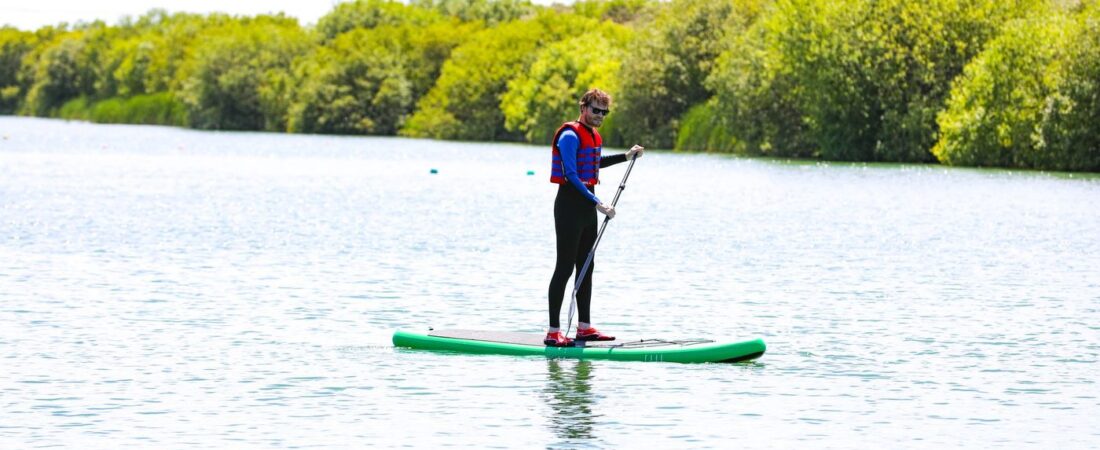
The legislation chapter says “personal flotation device” (PFD) covers all forms of lifejackets and buoyancy aids. It states that all persons on board any craft of less than 7 m in length must wear a PFD or lifejacket while on board an open craft, or on the deck of a decked craft, other than when the craft is made fast to the shore. The master or owner must make sure a PFD or lifejacket is carried for each person on board, and take all reasonable steps to make sure anyone under 16 wears one.
Chapter 7 repeats the point in its own words. Its personal safety equipment section tells the reader to wear a PFD/lifejacket and describes this as a legal requirement, and its SUP precautions say to wear a suitable PFD with a whistle to attract attention. Anyone unsure how the regulations apply to a particular board can read them on the Irish Statute Book.
Before leaving the shore
- Training: the Code says to get training from an approved provider. Canoeing Ireland’s scheme covers stand-up paddle boarding on inland waterways, and Irish Surfing is named as the national governing body for SUP.
- Clothing: wear appropriate clothing, for example a wetsuit.
- Leash: use one suited to the conditions, which the Code gives as an ankle leash for surf or still water and a quick-release waist-belt leash for flowing water.
- Skills: know how to tow another board.
- Information: check weather forecasts and water conditions, be aware of Marine Notices, local bye-laws and rules of navigation, and avoid restricted areas and busy swimming areas.
- Plans: tell a person ashore the departure and return times. The Code also recommends logging a Traffic Report message with the nearest Coast Guard Radio Station.
On the water
The Code says to be a competent swimmer, use the leash, and not paddle alone. Someone ashore should know the paddler’s location and return time, and the Code says to avoid paddling at night. On wind and water it says to paddle only in suitable and safe waters, understanding winds, tidal ranges and flows, and to avoid offshore winds and fast flowing waters.
It adds that wind can often overpower a paddle boarder, so there should be enough energy for the return journey, and that laying low on the board will reduce the wind area. Near other marine traffic, fairways or shipping lanes, the Code says a paddler’s profile on the water is almost invisible; it advises allowing enough time to cross and never crossing in front of shipping. It also says no one should be under the influence of alcohol or drugs to the extent of being incapable of proper control of the craft.
Phones, radios and beacons: two wordings
Different parts of chapter 7 word communication differently. The opening checklist says VHF radio equipment is the recommended method and that mobile phones should not be relied on and should only be considered as a back-up. The SUP precautions say to carry a handheld VHF radio or mobile phone in a waterproof cover. The SUP section also says to consider a Personal Locator Beacon, in particular when using a board alone, at sea and where unfamiliar with local currents.
If the water is a surprise
The Code’s “float to live” advice says that if a person unexpectedly falls into the water, the initial cold shock can cause gasping, uncontrolled breathing, breathing in water and panic. Without a PFD, it advises laying the head back with ears submerged, staying calm, floating or treading water to catch breath, and calling for help once calm. A properly fitted lifejacket, it says, will keep the head above water.
Local rules
The legislation chapter says a local authority, a harbour authority and Waterways Ireland have powers under section 6 of the Maritime Safety Act 2005 to make bye-laws for waters under their control. It says it is important to check with the relevant authority before going on the water to see whether any bye-laws apply.
The bottom line
For the Republic of Ireland, the Department of Transport’s Code treats a paddle board used for navigation as a recreational craft, sets out lifejacket, leash, training, weather and communication precautions, and cites the 2005 regulations for the law on wearing lifejackets. The Code describes itself as an educational resource, and its wording on phones differs between parts of chapter 7. For the law itself it points readers to the Irish Statute Book, and for bye-laws to the relevant authority.
Sources
- Code of Practice for the Safe Operation of Recreational Craft, Department of Transport, gov.ie, published 17 September 2024, last updated 5 June 2025, read 2 November 2026 (gov.ie)
- Chapter 7: Canoeing, kayaking and stand-up paddle boarding, Code of Practice for the Safe Operation of Recreational Craft 2024, Department of Transport (PDF text), read 2 November 2026 (assets.gov.ie)
- Chapter 1: Legislation, Code of Practice for the Safe Operation of Recreational Craft 2024, Department of Transport (PDF text), read 2 November 2026 (assets.gov.ie)
- Lifejackets and Personal Flotation Devices, Department of Transport, gov.ie, published 26 August 2019, read 2 November 2026 (gov.ie)